In brief
The B.Voc program in Computer Science (IT Specialist) is an industry-integrated course that prepares students for success in the dynamic world of information technology. Based on the internationally recognized Swiss dual vocational education system, the program combines academic learning with practical industry experience.
In the field of IT & Networking, we offer training in information storage, processing and communication. Computers are now part of everyday life. The range of information technology is growing at a rapid pace. This includes smartphones, the Internet, medical instruments, lighting technology and the use and control of robots and machines. The Faculty of Computer Science is also up to date in the field of networks such as LANs (local), wide area networks (WANs), intranets and extranets. The complexity of the network can vary depending on the organization. The Faculty of Computer Science also offers a doctoral program in which students can register for a doctorate in the field of the Internet of Things (IoT).
Goals
- It provides students with in-demand skills in areas such as cybersecurity, cloud computing, IoT and more. Graduates of this program are well-positioned for a variety of high-growth career opportunities in the IT sector that offer competitive salaries and the chance to work on cutting-edge technologies.
- Ability to install, configure and test CPE (modem, router and switches) for broadband access
- Establish the connection between the CPE and the end device (CPU, computer and Smart/IP TV etc.) at the customer’s premises
- Perform basic troubleshooting to identify, locate and rectify cable, connection and device faults
- Installation, configuration and testing of Wi-Fi devices and Wi-Fi access points for broadband access
- Establishing a connection between Wi-Fi nodes and access points at multiple locations
- Implementation, maintenance and integration of WAN, LAN and server architectures
- Implementation and management of network security hardware and software
- Enforce network security policies and comply with the requirements of external security audits and recommendations
Duration and admission criteria
- 3 years
- 10+2 (preferably PCM) or
- 2 years ITI after 10th grade or equivalent or
- Diploma holders who are entitled to lateral entry
Degrees
- Certificate (6 months)
- Diploma (1 year)
- Advanced diploma (2 years)
- Bachelor’s degree in vocational training (3 years)
- PhD (3 years without Bachelor)
Entry and exit possible after each semester

Career opportunities for computer scientists
- Network specialists or network service technicians focus on the setup, troubleshooting and repair of specific hardware and software products. Service technicians in particular can often travel to remote customer locations to perform on-site upgrades and support.
- Network administrators focus on the day-to-day management of networks.
- Network engineers focus primarily on system upgrades, evaluating vendor products and security testing.
- Network analysts and programmers write software programs or scripts that help with network analysis. These include, for example, diagnostic or monitoring programs. They also specialize in evaluating third-party products and integrating new software technologies into an existing network environment or setting them up in a new environment.
- Network managers oversee the work of administrators, engineers, technicians and/or programmers and focus on longer-term planning and strategy considerations.
- Network architects translate requirements created by functional analysts into the architecture of the solution. They describe these through architecture and design artifacts.
Infrastructure and equipment for computer scientists
The Faculty of Computer Science currently has the following laboratories and associated equipment:
Computer rooms: On the one hand, there is a computer room with 30 desktop computers (Intel i3 processors, 4GB RAM, 1TB HDD and 19″ monitors). On the other hand, there are three other rooms on campus that cover the computer needs of all students.
CISCO Networking Lab: This lab consists of rack-mounted routers, L2 and L3 switches, modems, firewalls, wireless devices, access points, fiber optic cables and network simulators. Students gain practical experience with network hardware and software in this lab.
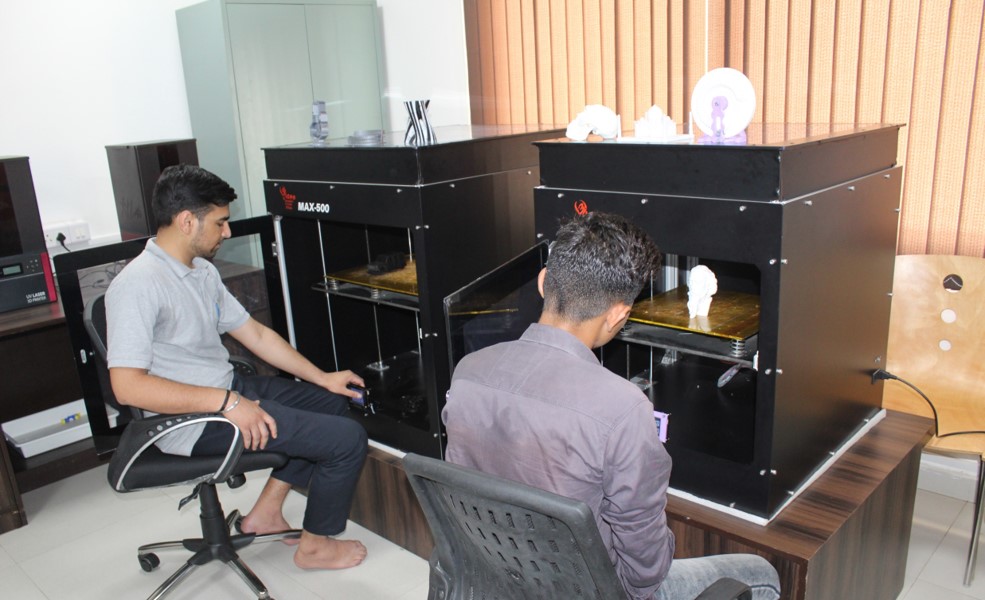
3D printing lab: It has nine 3D printers, four of which are of the SLA type and five of the FDM type. Various materials such as ABS, PLA, nylon, wood and PETG can be used. Training courses are offered here on an ongoing basis.
Research & Development Lab: This lab is used for the design and implementation of embedded systems and Internet of Things projects, such as:
- Water level indicator
- Smartphone-controlled household appliances
- Voice-controlled robotic vehicles
- Arduino-based digital clock + RH display
- Edge Follower robot
For more information, visit the website of the Faculty of Computer Science→ www.ruj-bsdu.in/computing-skills

Curriculum Engineer
Implement Swiss vocational education and training curricula in the Indian educational context—accurately, in line with the system, and remotely.
Learn more