
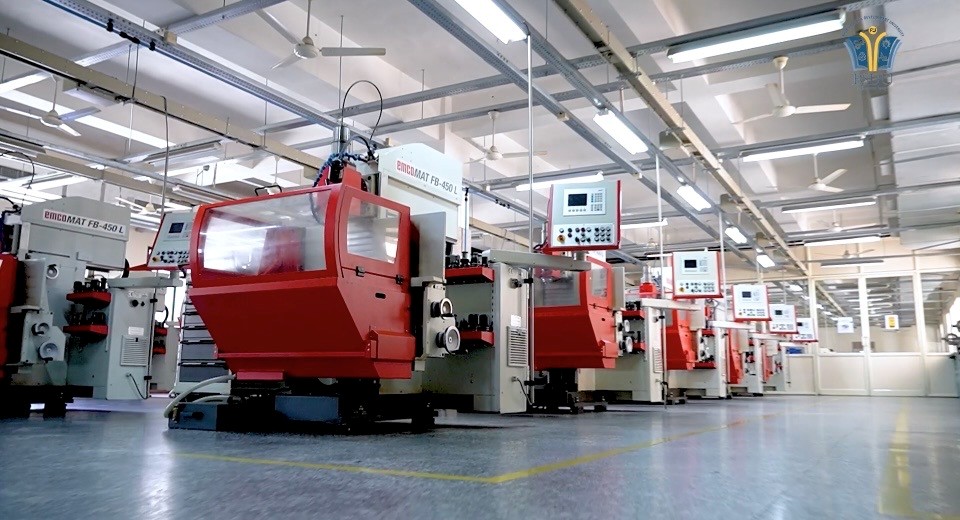
Why industrial skills development is becoming a location factor
Long-term industrial performance depends to a large extent on the availability of sufficient skilled workers who can safely master real processes and work reliably under operational conditions. This is precisely where the strategic importance of vocational training lies.
Universities alone are not enough. Resilient education systems that can develop skilled workers capable of working in industry under real conditions are crucial. Whether this ability is actually present usually only becomes apparent where quality has to function permanently in everyday industrial life.
The real misunderstanding of dual education systems
Internationally, the Swiss dual vocational education and training system is often reduced to a combination of school and company. However, this is precisely where a fundamental misunderstanding lies. The real strength of the system does not come from the model alone, but from the structure behind it:
- Clear responsibilities
- standardized competence frameworks
- Close cooperation with the business community
- Vocational trainers and coaches who ensure skills development in the real work process.

Professional competence does not develop automatically through lessons. It develops where learners have to work on real tasks, correct mistakes, take responsibility and repeatedly demonstrate their performance under comparable conditions, for example in official skills competitions such as the India Skills.
This is precisely one of the key differences between visible training models and actually functioning vocational training systems. Many education systems adopt the visible structure of dual training. It is more difficult to establish the institutional discipline that ensures the long-term development of skills under real industrial conditions.
Why system transfer often fails
It is precisely this ability to develop reproducible skills that does not arise by chance. It is the result of structures developed over the long term, clear responsibilities and a close connection between education and the real world of work.
This is why functioning vocational training systems cannot simply be exported. Many countries adopt visible elements of dual education systems without developing the underlying functional logic. Many systems adopt the visible architecture of dual training. It is more difficult to establish the institutional stability that makes skills development reproducible in the long term under real industrial conditions.
This is precisely where many transfer approaches fail.
India and the issue of industrial skills development
This question is becoming increasingly relevant for India. With the National Education Policy 2020 and the development vision “Viksit Bharat 2047″, there is growing pressure to link education more closely with industry, employability and economic development.
However, the real challenge does not lie in strategies or political programs. The decisive factor is whether institutions can organize skills development under real conditions in the long term.
DualEdu Bridge India as an adaptation approach
This is precisely where the DualEdu Bridge India project comes in.
The approach does not see system transfer as a copy of a foreign model. The focus is on the question of which principles actually work under India’s industrial, economic and institutional conditions.
This includes work-based learning, learning location integration and the direct link between training and real work processes. Workplace-integrated learning not only increases practical relevance. It reduces the distance between training and industrial reality.
Skilled worker development becomes a competitive factor
Reliable development of skilled workers is thus increasingly becoming a strategic location factor.
International companies have long since stopped evaluating locations solely on the basis of production costs. The decisive factor is whether there are enough qualified specialists available who can ensure industrial quality in the long term.
This is one of the biggest differences today between a fast-growing economy and long-term stable industrialization.
The real test
The coming years will show which institutions can build educational structures that remain sustainable in the long term.
The decisive factor will not be the number of new programs or partnerships, but whether learners can demonstrate their skills under real-life conditions. Many education systems appear convincing in the planning phase. However, their actual quality only becomes apparent in day-to-day operations, where acceptance, cooperation and culturally shaped working methods have a significant influence on long-term stability.
Sustainable industrial skills development does not happen in the short term. It develops gradually through functioning structures and the ability to permanently incorporate real economic and industrial conditions. In the long term, those institutions that do not primarily copy models but are able to develop their own sustainable solutions will gain in importance.
Do you have any questions about the project?
Send an e‑mail to: contact@joshi-foundation.ch
We will be happy to answer your question.
JCF Program Team
Rajendra and Ursula Joshi Foundation / DualEdu Bridge India
Rolf Siebold
For more insights into the development of skill universities and practice-oriented higher education, visit DualEdu Bridge India’s LinkedIn page.

