
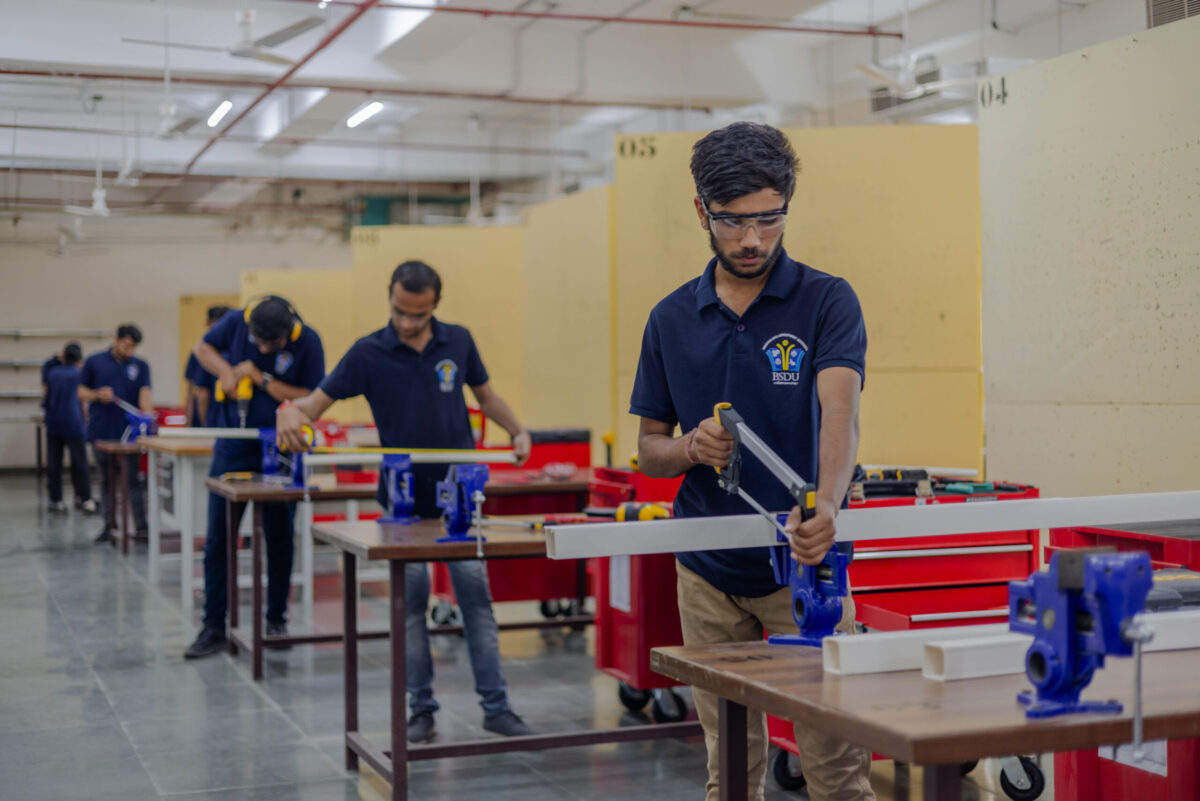
How can you really tell whether a training model is viable?
In India, there is increasing pressure to quickly expand models that work. With the growing interest in dual and hands-on approaches, the key question is: does apprenticeship help reduce the skills gap? skills gap and does this quality remain stable under different conditions?
As part of the IndiaSkills Competition 2025–2026, the DualEdu Bridge India project achieved the following results at national level:
- Gold in ICT Network & Infrastructure
- Silver in Autobody Repair
- Bronze in Renewable Energy
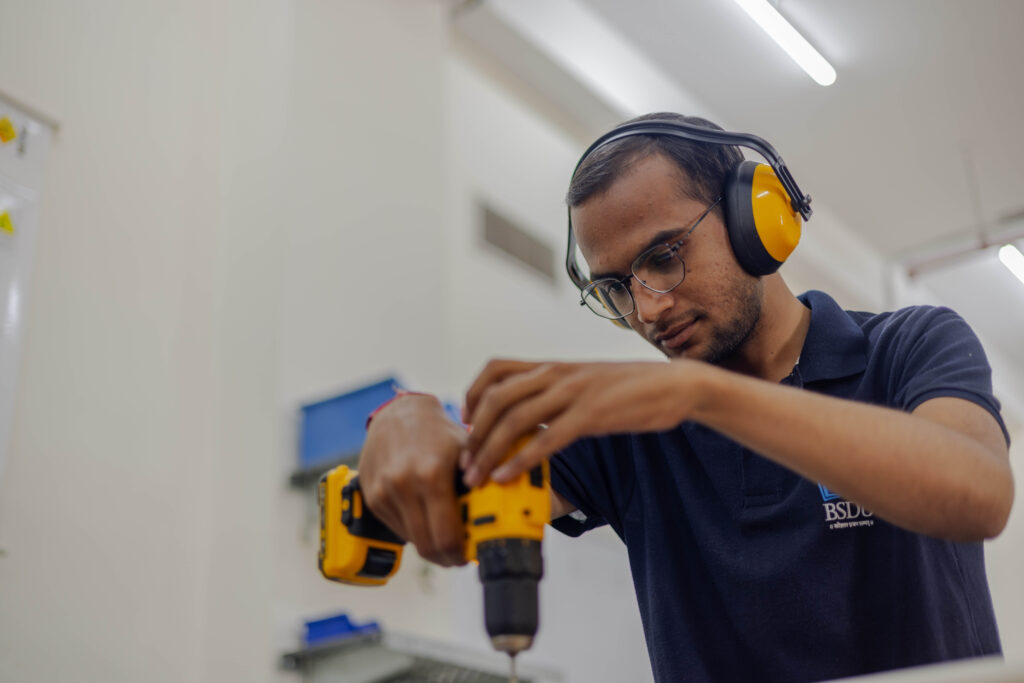
Across all competition levels — from regional and state level to national level — the Bhartiya Skill Development University achieved a total of 44 medals. These results show that the skills developed are not just selective, but can be applied under comparable conditions. This makes training quality visible and verifiable.
This also shows whether training actually contributes to reducing the skills gap .
An education system only becomes sustainable when those who later work with the results share responsibility. (Rolf Siebold)
Reliable scaling
The overarching goal is sustainable employability in the sense of Viksit Bharat 2047. The available results show that the approach works. However, the decisive factor is whether this quality can be maintained even as the number of participants increases.
This is not about expanding programs, but about the ability to reliably reproduce training performance. Only then can training systematically reduce the skills gap rather than selectively address it. This requires tasks that are geared towards real industry requirements, clearly defined performance requirements and an assessment that is based on the results achieved.
Orientation towards industrial work processes is central to this, as it determines what is considered performance. Within this framework, education specialists from the Rajendra and Ursula Joshi Foundation JCF are working together with Indian experts to consistently align training content with the requirements of the labor market.
This gradually creates a resilient structure in which training quality is not dependent on individual cases, but is reliably guaranteed.
However, the skills gap can only be sustainably reduced if the industry is structurally involved in training and assumes responsibility.
International experience with system scaling
A look at established dual systems shows that scaling is not achieved through speed, but through reliability in implementation. Programs are not simply expanded, but developed further in line with clear requirements.
India is pursuing a dynamic expansion, which creates additional pressure on the quality of implementation. This makes it all the more important to avoid mistakes, clearly define requirements, make tasks comparable and make results comprehensible.
On this basis, performance can be provided regardless of location and person. This comparability creates trust among learners and companies.
Scaling as an economic factor
When training performance is reliably produced under comparable conditions, its significance for the labor market changes. Companies can rely on graduates having the skills that are needed in the company.
This shortens training times and productivity is achieved more quickly. This approach is particularly effective where companies are actively involved in training.
Industry Mentor Training (IMT) structures this connection. Companies take on a clear role in the training process and thus ensure the practical relevance of skills development.
Conclusion
Scaling is a question of reliability. Only reliable training quality can sustainably reduce the skills gap .
The results of the IndiaSkills Competitions show that the DualEdu Bridge India project provides viable approaches. It is crucial to maintain this quality regardless of context and implementation.
Only then will an educational structure be created that enables sustainable educational performance.
Do you have any questions about the project?
Send an e‑mail to: contact@joshi-foundation.ch
We will be happy to answer your question.
JCF Program Team
Rajendra and Ursula Joshi Foundation / DualEdu Bridge India
Rolf Siebold
For more insights into the development of skill universities and practice-oriented higher education, visit DualEdu Bridge India’s LinkedIn page.

