Why sustainable impact requires system architecture
India is digitizing its higher education at a rapid pace. Platforms, hybrid programs and EdTech solutions are expanding access and reach. The National Education Policy 2020 sets a clear strategic framework for this.
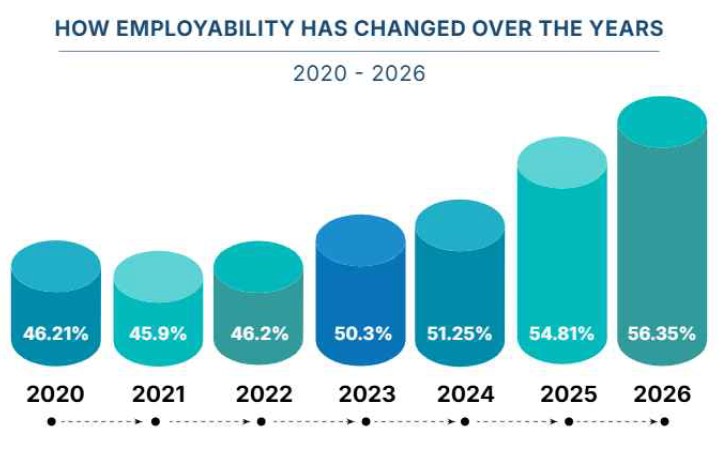
At the same time, the debate on employability is intensifying. The India Skills Report 2026 shows that although the employability rate has made progress, it is still well below a comprehensive level of employability. A relevant proportion of graduates are not considered immediately employable.
This development must be seen in the context of a rapidly growing higher education landscape. The currently available (provisional) AISHE data for 2022–23 shows a total enrolment of 43.3 million students. The system is therefore expanding significantly in terms of size and participation. (Ministry of Education, AISHE 2022–23 (Provisional), Government of India).
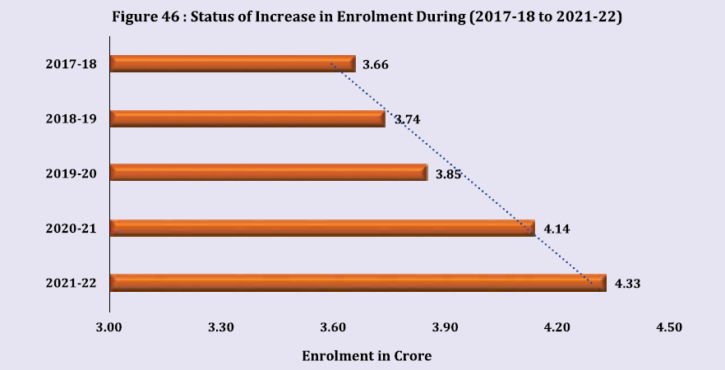
This parallelism is not a contradiction, but an expression of a structural challenge. Increasing participation in education does not automatically generate validated skills relevant to the labor market.
Where system components are not synchronized, digitalization scales qualification signals faster than real performance. However, this also widens the skills gap.
How must digital reform be designed so that it builds real competence and makes the transition to the labor market reliable?

Digital skills and employability in India
Digital learning formats enable scaling, flexibility and reach. They expand access to education and accelerate knowledge transfer.
The efficiency of learning formats should not be equated with skills development.
Professional competence is developed through application in real work processes, situational decision-making and verifiable proof of performance. Digital assessments often measure knowledge reproduction. Work processes, on the other hand, require process stability, assumption of responsibility and problem solving under real conditions.
If digital offerings are implemented without binding work process-related components, formal qualifications are created without reliable skills validation. This results in longer induction periods, additional in-company training costs and uncertainty regarding the actual performance of graduates.
The key question is therefore not whether digitalization is taking place, but whether digital learning formats are structurally synchronized with skills development relevant to the labour market. Without system coherence, digitalization increases decoupling from the needs of the labour market. With system coherence, it increases productivity.
Institutional responsibility
Digital educational offerings are shifting responsibility structures. While curriculum, teaching and examination are clearly institutionally located in analog formats, new players and interfaces are emerging in the digital space.
Platforms, IT and external partners take on partial functions. However, responsibility for learning outcomes remains with the institution.
Without clear governance, this shift leads to fragmentation: parallel systems, inconsistent evaluation logics, unclear data sovereignty.
Digitalization is therefore not primarily a technical issue, but an institutional one. Sustainable impact can only be achieved where responsibilities are defined and embedded in a consistent system architecture.
DualEdu Bridge India as a reference model
DualEdu Bridge India sees digitalization not as an add-on, but as part of the overall educational structure. Technology is specifically integrated into the curriculum, assessment and management.
Industry partners take on clear tasks in training and in the assessment of skills. Training and the labor market are structurally linked.
Digital vocational training is understood as infrastructure. For example, through a structured digital feedback process in which industry partners evaluate the performance of graduates after six months in the company. This feedback is systematically incorporated into the further development of the curriculum and examination design. In this way, digitalization becomes a steering instrument for quality and not just for the dissemination of content.
In line with the National Education Policy 2020, this approach shows that sustainable impact is achieved through clear responsibility and clean governance, not through the platform alone.
Conclusion
Platforms help with access. However, the decisive factor is who is responsible for what, how skills are checked and how quality is managed. Only when these rules are in place will digitalization have a lasting effect.
Do you have any questions about the project?
Send an e‑mail to: contact@joshi-foundation.ch
We will be happy to answer your question.
JCF Program Team
Rajendra and Ursula Joshi Foundation / DualEdu Bridge India
Rolf Siebold
Follow DualEdu Bridge India on LinkedIn for ongoing
insights into vocational education reform
Last entries
- Governance in higher education
- Quality management in vocational education and training: no scalability without monitoring
- System architecture and labor market capability in India
- Digitalization in vocational education and training
- DualEdu Bridge India: Why education reform starts with system architecture
Categories