
Why institutional structures determine the success of educational reforms
Many countries are reforming their higher education systems. Programs are being created, courses of study are growing and political strategies are being adopted. But one central question often remains unanswered: Where is it actually decided whether these reforms actually lead to employable skills?
In many countries, the reform of higher education has become a key economic policy task. Programs are designed to improve the employability of graduates, promote innovation and meet the demand for skilled workers in growing industries.
However, the experience of many education systems shows that reforms rarely fail due to a lack of ideas. They usually lose their impact where political programs are not sufficiently anchored in institutional structures.
Between political reform strategies and the actual competencies of graduates lies a level that is often underestimated in reform debates: The governance and organizational structure of universities.
The crucial question is therefore not only which reforms are adopted, but where their actual impact will be decided.
The structural tensions of modern higher education systems
Modern higher education systems operate in a field of tension between three central players.
- Governments often measure reforms in terms of programs, participation rates or the expansion of study opportunities.
- Universities are guided by the development of new degree programs, student numbers and degrees awarded.
- Companies, on the other hand, evaluate the system from a different perspective: for them, it is primarily the practical skills of graduates that count.
Employers therefore ask a simple question: are graduates able to work productively?
These three perspectives follow different logics. Without stable governance structures, structural imbalances often arise. The institutional structures of a university are decisive. They determine whether reform programs lead to real skills development or remain mainly on paper.
The result is a familiar pattern in many education systems: The number of degrees increases, but the actual employability of graduates does not automatically improve.
Governance as a link between reform policy and employability
This is where the importance of governance in higher education becomes apparent.
Political reforms define strategic goals. However, the concrete impact of these reforms is created within the institutions. At universities, curricula are developed, teaching and learning processes are organized, industry partnerships are established and performance records are designed.
This institutional architecture — i.e. decision-making structures, responsibilities and quality assurance processes — ultimately determines whether reform programs lead to real skills development or remain predominantly programmatic in nature.
Governance is therefore less an administrative issue than a mechanism that combines political objectives with the practical requirements of the labor market.
The limits of project-based reform policy
Many reform initiatives are implemented via projects, funding programs or temporary pilot projects. Such initiatives can trigger innovations and provide important impetus.
However, their impact remains limited if they are not permanently anchored in institutional structures.
As soon as funding programs end or the people responsible change, many of these projects lose their operational impact. Instead of sustainable structural changes, a large number of isolated initiatives emerge.
Reforms that focus primarily on projects often lead to new programs, but rarely to stable institutional structures.
Institutional innovation as a starting point for systemic development
This area of tension is particularly evident in the development of new practice-oriented degree programs.
Such programs are often initially created within individual universities. Institutions develop new curricula, work together with industry partners and test training models that are more strongly oriented towards real work processes.
However, the decisive question is not just whether a degree program exists. The decisive factor is whether its structure is understandable and connectable beyond the individual institution.
Programs gain systemic importance when several elements come together. These include clearly defined professional target roles, skills profiles that can be classified in national qualifications frameworks and structured cooperation with industry partners.

Equally important is a transparent assessment structure that makes skills development verifiable.
When these elements interact, the role of a degree program changes fundamentally. It is then no longer merely a local university offering, but an institutionally developed model with structural connectivity.
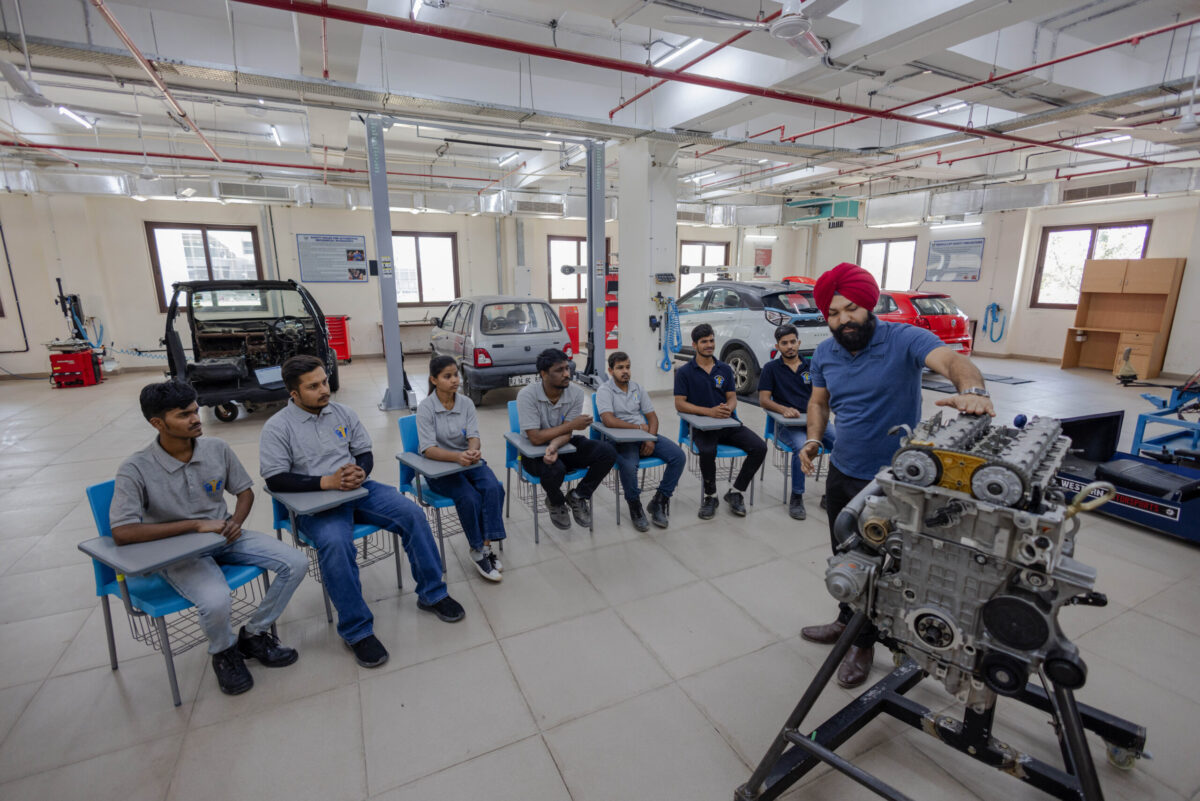
Such institutional training architectures are often initially created within individual universities. An example of this is currently being developed at the Bhartiya Skill Development University in Jaipur.
As part of the DualEdu Bridge India approach, study programs are developed specifically along industrial competence profiles, practice-oriented training structures and international training experiences.
The approach combines academic programs with industrial training processes and thus creates degree programs whose structure can be connected beyond individual institutions.
In such cases, a degree program can serve as a reference model for sectoral training standards.
From institutional models to national qualification standards
In many education systems, viable reform models are not created by political programs alone. Robust training architectures often first develop within individual institutions where new approaches are tested in practice.
Skill universities in particular play an extremely important role in this context. Their programs combine academic education with industrial practice and skills-based training.
Institutions such as the Bhartiya Skill Development University show how such models can be developed. Initiatives such as the EduBridge India reference model combine international training experience with the requirements of industrial practice.
Programs that are based on clear outcome structures, industrial integration and comprehensible competence profiles can thus gain significance beyond individual institutions.
NEP 2020 and the next phase of higher education reform
The National Education Policy 2020 has created an important framework for the further development of higher education. It emphasizes employability, practice-oriented education and stronger cooperation between universities and industry.
However, a further question arises for the further development of this reform agenda.
It is not just about introducing further programs. The decisive factor is which institutional models already have an architecture that is suitable for broader sectoral application.
Programs with a clear outcome logic, structured industry integration and comprehensible competence profiles could serve as reference models for the further development of sectoral training standards.
Conclusion: Institutional architecture determines the impact of reform
Programs develop quickly. Institutional structures grow slowly.
For reforms to be effective, politics, universities and industry must clearly coordinate their roles and work together on a permanent basis.
If such structures are created, individual programs can gain significance beyond a single university. They become points of reference for new training standards and show how reform goals can be implemented in practice.
This opens up an important perspective for education systems: institutionally developed training models can serve as a reference for operationally anchoring reform programs and further developing sectoral standards.
Do you have any questions about the project?
Send an e‑mail to: contact@joshi-foundation.ch
We will be happy to answer your question.
JCF Program Team
Rajendra and Ursula Joshi Foundation / DualEdu Bridge India
Rolf Siebold
For more insights into the development of skill universities and practice-oriented higher education, visit DualEdu Bridge India’s LinkedIn page.

