The public and political debate on education systems in India is dominated by quantitative indicators. Enrolments, graduation rates, program numbers or growth rates are visible, comparable and relevant for management. They make it possible to measure expansion and communicate progress.
Qualitative factors such as skill level, teaching quality and employability are more complex to measure. Their effect often only becomes apparent in the labor market and therefore with a time lag. This is where a structural shift becomes apparent: what is easily measurable dominates management. What generates long-term performance often only becomes visible when it is lacking.
However, system architecture and employability in India cannot be derived from growth figures. Labor market readiness arises where learning, application and assessment are structurally linked and education is interlinked with real value creation.
This shifts the discussion from expansion to performance. The decisive factor is not the number of qualifications, but how the education system is constructed and how consistently it makes skills effective in the labor market.
When education grows, but expertise does not grow to the same extent
India is rapidly expanding its higher education system. The number of graduates is rising continuously and the system is growing in scope and reach. Measured by quantitative indicators, this development appears successful. However, system architecture and labor market capability in India cannot be derived from this expansion alone.
At the same time, a central challenge remains: Many graduates are not immediately available for productive employment. This simultaneity is not a contradiction, but rather an indication of a structural shift. Education is expanding faster than its systematic connection to real value creation processes.
More qualifications do not automatically lead to increased performance. The problem therefore lies not in access to education, but in the lack of a structural link between learning and working.
A look at the current HR debate in India shows how deep the discrepancy between the training on offer and the labor market really is. In The Employability Landscape in India it becomes clear that despite huge talent pools and growing university participation, there are still considerable gaps between the existing skill levels and the actual requirements of many employers.
This finding underscores that structural factors beyond purely quantitative measures such as enrollment or graduation rates are crucial to truly understanding and improving employability.
Why cooperation alone is not effective
Cooperation between industry and universities in India is often seen as a direct lever for employability. More partnerships should create practical relevance, more industry projects should stabilize the transition to employment. After all, employability is an economic production factor.
Cooperation alone does not create competence. As long as it is organized on a project basis, supported by individuals or limited to symbolic proximity, activity is created, but not a reliable structure. Internships without a clearly defined learning architecture are no substitute for the systematic integration of real work processes into the curriculum.
Employability is the result of a clear alignment between curriculum, practice and real-world value creation
Architecture beats intention: the role of governance
At this point, the focus shifts from mere activity to architecture. The decisive factor here is not how much cooperation takes place, but how this cooperation is structurally anchored.
System architecture means that roles are defined, responsibilities are clearly defined and standards are binding. Companies take on specific functions in skills development, evaluation is integrated and results are verifiable. It is only through this structure that employability in India emerges as a reproducible result.
DualEdu Bridge India deliberately operationalizes this connection. The mechanism of action can be clearly formulated:
Impact = (Standards + Governance + Industry Integration) × Measurable Outcomes
International dual education systems make this logic visible. In Switzerland, Germany and Austria, the dovetailing of company and education is an integral part of the architecture. Companies are involved in the design of curricula, participate in skills assessments and assume defined functions in training management.
Quality there does not depend on the commitment of individuals, but on a stable structural foundation that makes performance reproducible.
Work-based learning as a constructive principle
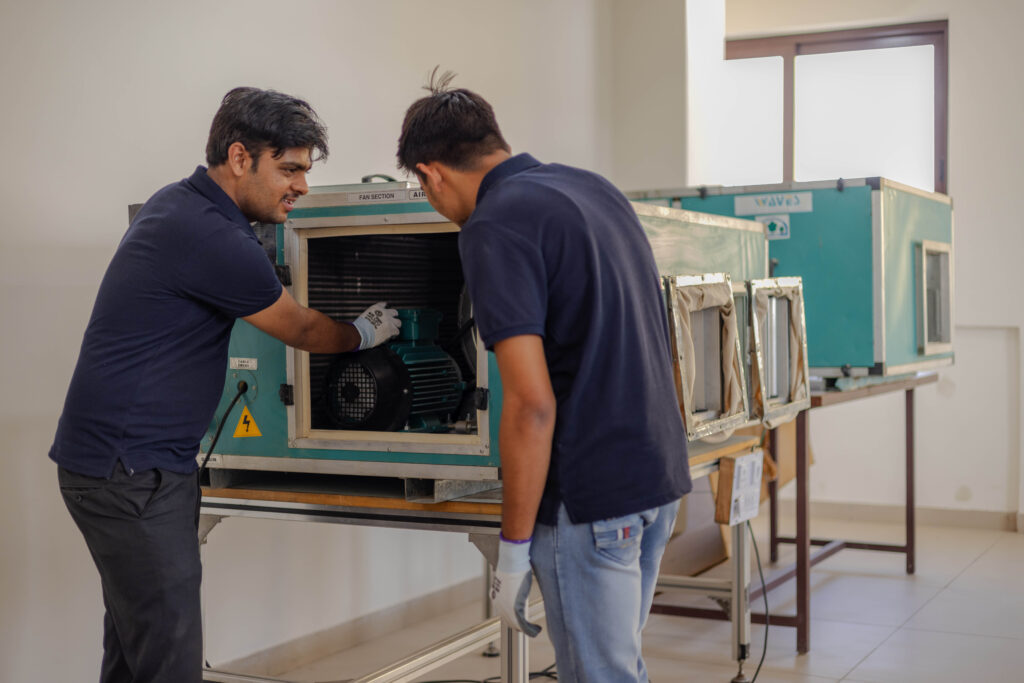
In this context, work-based learning is a design principle of the entire training program. Work-based learning phases are anchored in the curriculum, assessed and documented; industry partners take on clearly defined functions in skills development, not just advisory roles.
Competence is not simulated, but built up and tested under real conditions. Performance requirements are formulated transparently and evaluation has a steering effect. In this way, there is no selective proximity to the labor market, but rather a systematic integration of value creation logic into the educational process itself.
Employability arises where application does not remain optional, but is structurally embedded.
When structure becomes measurable: The stress test of the Skill Competitions
Every architecture has to prove itself — not in presentations, but under real performance conditions.
IndiaSkills 2025–26 offers exactly this endurance test. At the West Region Finals, 19 finalists from Bhartiya Skill Development University competed and 12 of them won medals. A conversion rate of 63.2 percent under competitive conditions, including three gold, four silver and five bronze medals.

At the same time, 13 Rajasthan State participants, who were prepared in structured boot camps, also won medals.
Out of a total of 35 medal winners from Rajasthan, 25 were trained by BSDU — 71.4 percent.
These figures are a performance indicator.
Skill competitions test applicable skills under time pressure, with standardized tasks and external assessment. They do not measure the reproduction of knowledge, but the stability of performance. If an institutional model performs consistently there, this is an expression of a functioning architecture.
Medals are an empirical proof of performance. They show that clear standards, qualified trainers and structured industry integration work together effectively under real conditions.
From education reform to economic infrastructure
Cooperation between industry and universities in India only counts when it has a tangible effect. When training and real work requirements really match, familiarization times are shortened. Additional training becomes easier to plan. Continued employment after training becomes more likely.
At the same time, recruitment costs are reduced because wrong appointments become rarer and selection processes function more precisely. Money and time are then spent on productive work rather than on corrections.
The decisive question is therefore not whether cooperation takes place, but whether it is organized in such a way that competence is actually sustainable in the company.
The economic effects extend beyond individual companies.
In the context of Viksit Bharat 2047 , this means something concrete: a developed economy needs people who can execute, not just have degrees. Growth comes not only from investment, but from reliable competence in the work process.
In the end, it is not the number of degrees that is decisive, but the reliability of the competence that a system actually produces.
Last entries
- Why BSDU is different
- India in an international comparison of vocational education and training
- When training quality becomes measurable
- Medal successes at the IndiaSkills 2025–2026, National Level
- Instructor and trainer development
- Why the quality of vocational training is decided on a day-to-day basis
- Governance in higher education
Categories
Do you have any questions about the project?
Send an e‑mail to: contact@joshi-foundation.ch
We will be happy to answer your question.
JCF Program Team
Rajendra and Ursula Joshi Foundation / DualEdu Bridge India
Rolf Siebold
Follow DualEdu Bridge India on LinkedIn for ongoing
insights into vocational education reform